The Four Whispers: a simple way to look after how you feel
Most of us were never taught what to do with a feeling. Here is a simple way to think about it, in four small steps, for the ordinary days.
We were taught how to study, how to work and how to manage a spreadsheet. Nobody taught us what to do when a Sunday evening feels heavy, or we snap at someone we love, or we lie awake replaying a conversation. I didn't know either. I wanted a way through that I could do myself, and what helped me came down to four small moves.
I call them The Four Whispers: Notice, Settle, Reframe, Act. Each one is a quiet thing you say to yourself. None of them needs special equipment, a perfect mood or a free hour.
All the ideas come from research on emotion regulation, self-compassion and habit change.
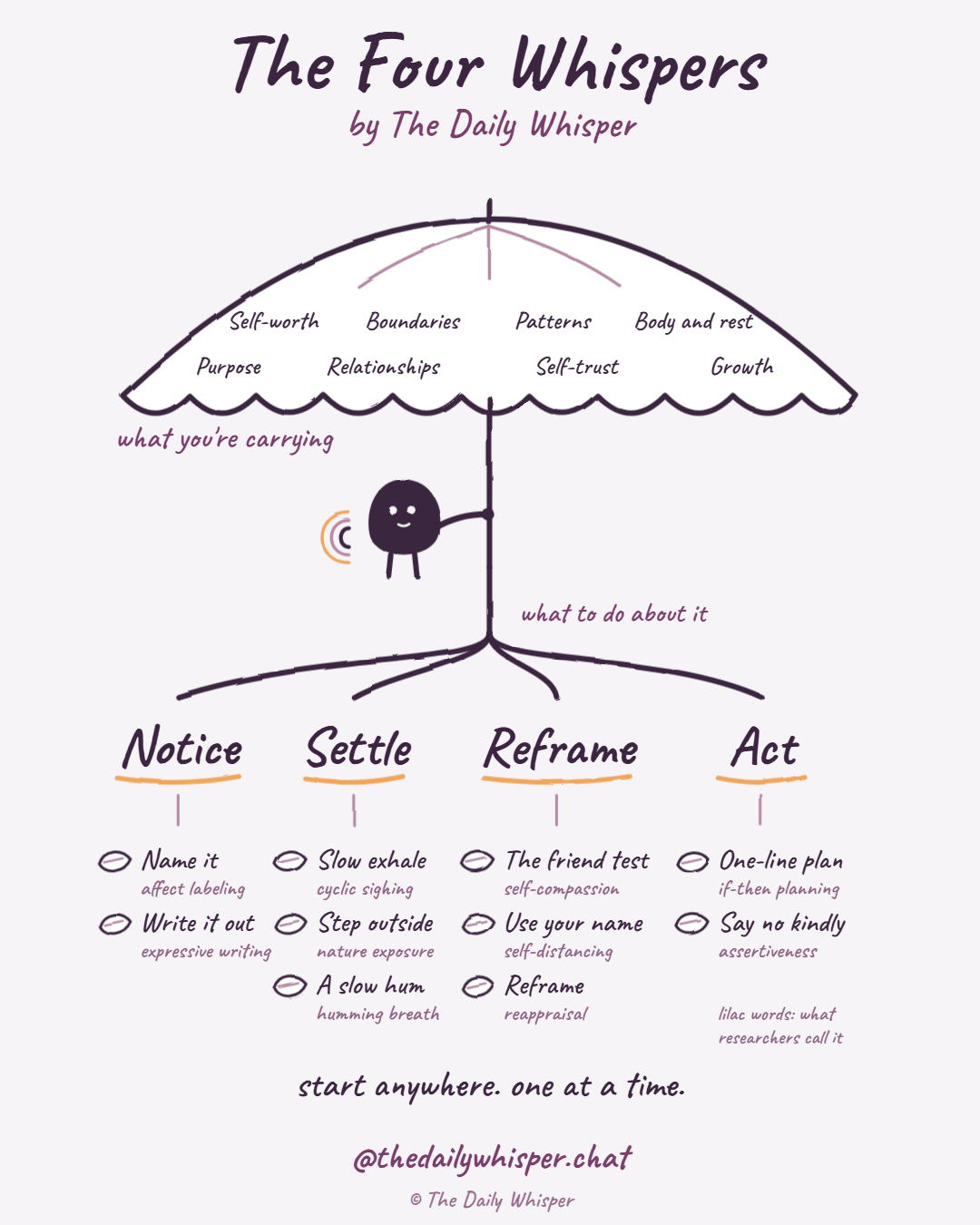
Reading the picture
The picture has two halves.
The umbrella is what you are carrying. Under it are eight areas of life: purpose, self-worth, relationships, boundaries, patterns, self-trust, body and rest, growth. These are the things people most often carry. Everyone has some of them, and on any given day one or two feel heavier than the rest.
The tree is what you can do about it. Its four branches are the four whispers: Notice, Settle, Reframe and Act. The leaves on each branch are small techniques you can try today. Under each technique, the lilac words are what researchers call it, in case you want to look it up.
The Whisper joins the two. Our small character holds the umbrella handle, and the handle is the trunk of the tree. Whatever you are carrying, the same four whispers are there for it.
Notice
Everything starts here. You can't do anything with a feeling until you know it's there, and most of us are good at moving past it.
Noticing can be as simple as finishing the sentence "Right now I feel..." with the most exact word you can find. Putting feelings into words has been shown to calm the brain's threat response (Lieberman et al., 2007). Writing things out belongs here too, and it's what helped me most.
Settle
When you're wound up, thinking won't help yet. Settle means calming your body first, and letting your mind catch up.
A long, slow exhale is one way. In one small study, five minutes a day of breathing with a long exhale lifted mood more than meditation did (Balban et al., 2023). Going outside is another. In another study, people who walked for 90 minutes in nature reported less rumination than people who walked in a city (Bratman et al., 2015). A slow hum is a third. Some people find a long, slow hum on the exhale calming. The research on humming itself is early and small, so treat it as something to try, and keep what helps.
Reframe
A thought is not a fact. "I'm failing" is a thought. "I missed one deadline" is a fact. Reframing means putting a little distance between you and the thought.
You can ask what you would say to a close friend who told you the same thing. Treating yourself that way has been linked to less stress and less self-criticism (Ferrari et al., 2019). Or you can talk to yourself by name, which has been shown to help people feel less distressed under stress (Kross et al., 2014).
Act
Noticing, settling and reframing only go so far if nothing changes. Act is about turning what you've learned into one small thing you do.
A simple way is an if-then plan: "When I notice my shoulders tighten, I'll take three slow breaths." Plans like this have been shown to help people follow through on what they intend (Toli et al., 2016). Saying no without the guilt belongs on this branch, and I'll write about it soon.
How to use it
Start anywhere. You don't go in order, and you don't need all four. Pick the branch that fits today. Notice on a foggy day. Settle on a frantic one. Reframe when the voice in your head is loud. Act when you know what would help and keep not doing it.
One at a time is plenty.
How The Daily Whisper uses it
The questions and replies in The Daily Whisper draw on techniques like these. You won't hear the names. You'll get one question a day and one small thing to try, chosen for what you wrote.
The Four Whispers is everyday reflection. It is not therapy or medical advice, and it doesn't replace the people and professionals in your life.
When it's more than everyday. If you can't function, if things have felt heavy for weeks, or if you're having thoughts of harming yourself, please speak to a professional. In the UAE you can call 800 HOPE (800 4673) or 800 SAKINA (800 725462), free and confidential, in English and Arabic.
If one of these sounded like you, start with that one. Megha
One question a day, on WhatsApp. No card needed.
Questions about The Four Whispers
What is The Four Whispers?
The Four Whispers is a simple way to look after how you feel on an ordinary day, from The Daily Whisper. It has four steps: Notice, Settle, Reframe and Act. Each step has small techniques you can try today, with research behind them.
What do Notice, Settle, Reframe and Act mean?
Notice means seeing what you are feeling and what sets it off. Settle means calming your body so you can think. Reframe means changing how a thought lands. Act means turning what you notice into one small thing you do.
Do I have to do all four steps?
No. Start anywhere, and pick the step that fits today. One at a time is plenty.
Where do the ideas in The Four Whispers come from?
They come from research on emotion regulation, self-compassion and habit change. The studies are listed at the end of the post.
Is The Four Whispers therapy?
No. It is everyday reflection, and it is not therapy or medical advice. If things have felt heavy for weeks, please speak to a professional.
Sources
- Balban, M. Y., et al. (2023). Brief structured respiration practices enhance mood and reduce physiological arousal. Cell Reports Medicine.
- Bratman, G. N., et al. (2015). Nature experience reduces rumination and subgenual prefrontal cortex activation. PNAS.
- Ferrari, M., et al. (2019). Self-compassion interventions and psychosocial outcomes: a meta-analysis of RCTs. Mindfulness.
- Kross, E., et al. (2014). Self-talk as a regulatory mechanism: how you do it matters. Journal of Personality and Social Psychology.
- Lieberman, M. D., et al. (2007). Putting feelings into words: affect labeling disrupts amygdala activity. Psychological Science.
- Toli, A., Webb, T. L., & Hardy, G. E. (2016). Does forming implementation intentions help people with mental health problems to achieve goals? British Journal of Clinical Psychology.